In the ever-evolving landscape of search engine optimization, On-Page SEO techniques remain the bedrock of a high-ranking, high-converting website. While off-page factors like backlinks build authority, it’s the on-page work—the elements you directly control—that tells search engines exactly what your content is about and why it’s the best answer for a user’s query.
Mastering on-page optimization is more than just scattering keywords; it’s about aligning your content with Google’s quality and experience standards, known as E-E-A-T (Experience, Expertise, Authoritativeness, and Trustworthiness).
This guide serves as your comprehensive, 15-point checklist. We will move beyond the basics of title tags and meta descriptions to cover advanced technical factors like Schema Markup and Core Web Vitals. By implementing these on-page SEO techniques, you will bridge the gap between your current performance and the top-ranking competitors in your industry.
Part 1: The Core Content Pillars (E-E-A-T and Keyword Strategy)
High-ranking pages prioritize a user-first, comprehensive approach to content. This section focuses on the quality signals that communicate E-E-A-T.
1. Match and Satisfy Search Intent
The single most critical on-page SEO technique is understanding why a user is searching. Before writing a single word, analyze the current Search Engine Results Page (SERP) for your primary keyword, “on-page SEO techniques.”
- Informational: Are the top results comprehensive guides and checklists? (This suggests your content must be a detailed “How-To”).
- Transactional: Are the top results product pages or services? (This means you need a strong, service-oriented CTA).
- Navigational/Commercial: Are users looking for specific brands or comparisons?
Action: Ensure your article’s format (a detailed guide/checklist) matches the dominant informational intent of this keyword. Your content must comprehensively answer all questions a searcher might have.
2. Strategic Keyword Placement and Density
While keyword stuffing is penalized, the natural, strategic placement of your primary and supporting keywords is essential.
- Primary Keyword: “On-Page SEO Techniques” must be included naturally in:
- Your Title Tag (near the start).
- Your H1 Tag.
- The first 100-150 words of your content.
- The final conclusion/summary.
- At least two H2 headings.
- Secondary & LSI Keywords: These are related terms that prove topical completeness. Integrate supporting keywords like: “on-site optimization,” “page speed,” “Core Web Vitals,” “Schema Markup,” “user experience,” and “keyword mapping.” This signals to Google that you have deep expertise on the subject.
3. Structure Your Content with a Clear Hierarchy (H1-H6)
Headings are the roadmap for both users and search engine crawlers. A well-structured document improves readability and helps Google parse out key information for rich snippets.
- Use one and only one H1 tag for the main title.
- Use H2 tags for the primary sections of your guide (e.g., “Core Content Pillars,” “Advanced Technical Factors”). Include your primary or secondary keywords in these.
- Use H3 tags for sub-topics and specific examples under the main H2s (e.g., “3.1. Title Tag Optimization,” “3.2. Image Alt Text Best Practices”).
4. Optimize for Content Scannability and Readability
A poor user experience (UX) is bad for SEO. Even if your content is long and authoritative, it must be easy to read.
- Use Short Paragraphs: Never let a paragraph exceed 3-4 lines.
- Employ Bullet Points and Numbered Lists: Break down complex steps and technical specifications into easily digestible lists (like this one).
- Bold Key Phrases: Use bolding to highlight important takeaways, making the content scannable.
Free Resource: Is Your Website Leaving Money on the Table?
If the complexity of these on-page SEO techniques feels overwhelming, you don’t have to manage it alone. Download our exclusive “Printable On-Page SEO Checklist” right now—and while you’re at it, ask about our free, no-obligation SEO audit to identify your biggest ranking gaps.
Part 2: High-Impact HTML Optimization (The Click-Through Rate Masters)
These elements appear in the SERPs and are your page’s first impression. Optimizing them directly boosts your Click-Through Rate (CTR)—a major ranking signal.
5. Craft a Click-Worthy Title Tag
Your title tag is your advertisement on the SERP. It must be compelling and contain your primary keyword.
- Include the Keyword: Place “on-page SEO techniques” close to the front.
- Add Modifiers: Use words like “Ultimate,” “Guide,” “Checklist,” “Definitive,” or a number (e.g., “15-Point”) to signal value.
- Length: Keep the length under 60 characters (or ~600 pixels) to avoid truncation.
6. Write a Compelling Meta Description
While not a direct ranking factor, a well-written meta description is your sales pitch.
- Use a Call-to-Action (CTA): Encourage the user to click (e.g., “Discover,” “Learn,” “See How”).
- Include the Keyword: Google will bold your keyword when it matches the search query, increasing visibility.
- Length: Aim for 150-160 characters. Highlight a key benefit or feature of the content (e.g., “boost your rankings immediately”).
7. Optimize URL Structure
Your URL should be short, descriptive, and contain your primary keyword.
- Current URL (Excellent):
https://elfoett.com/on-page-seo-techniques/ - Best Practice: Use hyphens (
-) to separate words, not underscores (_). Keep it short and remove unnecessary stop words (a, the, of).
8. Image Optimization for Speed and Context
Images help with UX, but slow-loading images kill rankings.
- Descriptive File Names: Use keywords instead of generic names (e.g.,
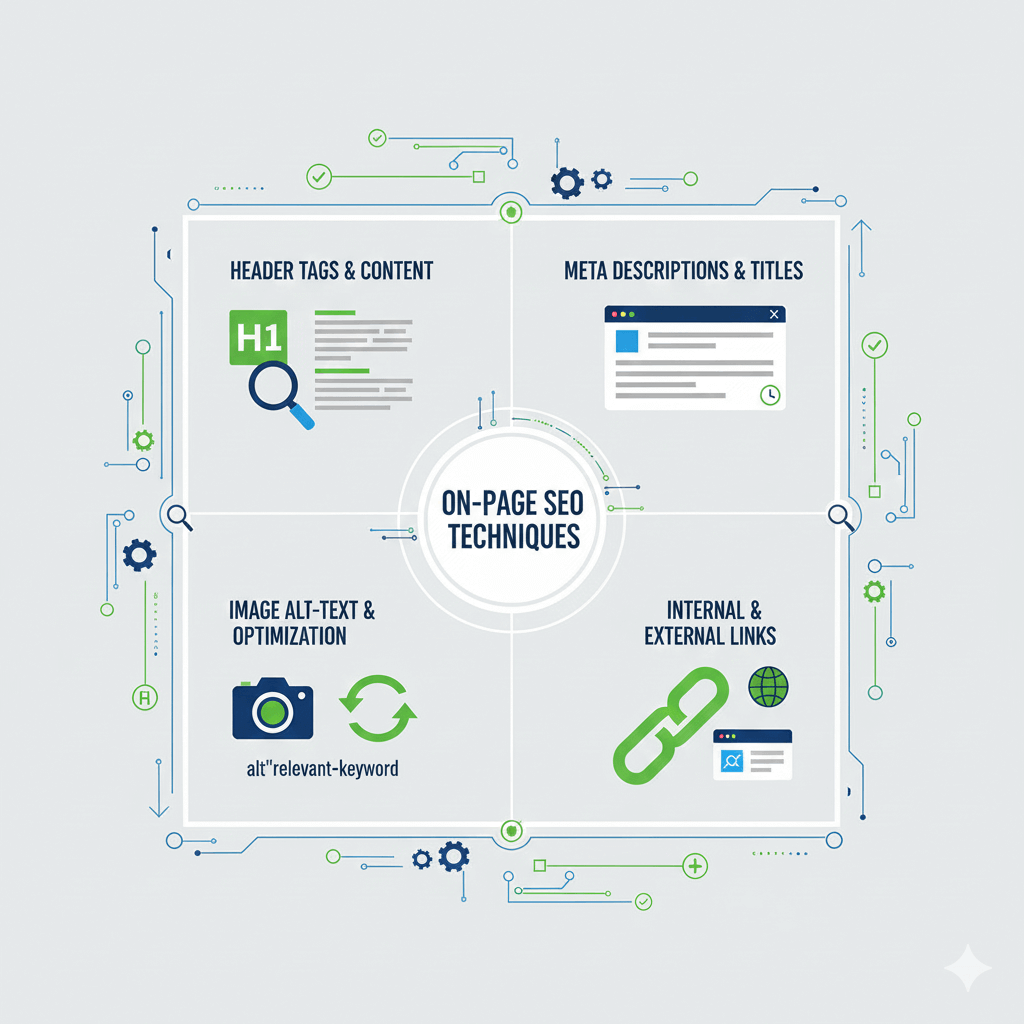
on-page-seo-checklist.webpinstead ofIMG0045.jpg). - Alt Text: This is the image’s SEO. Describe the image accurately for visually impaired users and for search engines. Include your keyword naturally where relevant:
alt="Infographic showing a 15-step on-page SEO techniques checklist for website optimization." - Compression: Compress images (using tools like TinyPNG) and use modern formats like WebP or AVIF for faster loading times.
Part 3: Advanced Technical On-Page (Unlocking Top Tier Rankings)
To surpass your competitors, you must implement the technical optimizations that affect how search engines understand and serve your content.
9. Implement a Strategic Internal Linking Structure
Internal links help Google understand the structure and authority of your website, a concept often called “link sculpting.”
- Use Keyword-Rich Anchor Text: Link this article, using variations of “on-page SEO techniques” as anchor text, from other relevant, high-authority pages on your site.
- Link to Your Key Pages: Use this high-traffic guide to funnel authority to your Service Pages (e.g., link “SEO audit” using that phrase to your main audit service page).
- Contextual Links: All links should be placed naturally within the body text where they add value to the reader.
10. Link Out to Authoritative External Sources
High-quality external links are a critical component of E-E-A-T. They demonstrate that your content is well-researched and grounded in credible sources.
- Quality Over Quantity: Only link to highly respected domains (e.g., Google Search Central, major SEO tool providers).
- Relevant Links: Ensure the external link adds genuine value or substantiates a claim made in your article.
11. Leverage Schema Markup for Rich Results
Schema Markup (Structured Data) is code that helps search engines immediately understand the context of your content, leading to higher visibility via Rich Snippets.
- Article Schema: Implement this immediately to clearly mark your content as a Blog Posting.
- FAQ Schema: Since this is a comprehensive guide, format several key questions and answers into FAQ Schema to earn a dedicated spot in the SERP results (e.g., “What are the most important on-page SEO factors in 2025?”).
- How-To Schema: If you break down a complex technique into steps, use How-To Schema for a step-by-step rich result.
12. Optimize for Page Speed and Core Web Vitals (CWV)
CWV—which includes metrics like Largest Contentful Paint (LCP), First Input Delay (FID), and Cumulative Layout Shift (CLS)—are official Google ranking factors focused purely on user experience.
- Minimize LCP: Ensure the main content on your page loads instantly by optimizing images and deferring non-critical CSS/JavaScript.
- Improve Mobile Experience: Your page must be 100% mobile-friendly and responsive, as Google uses mobile-first indexing for ranking.
- Use Caching: Leverage browser caching and consider a Content Delivery Network (CDN) to ensure fast, global delivery of your content.
Part 4: Sustaining Authority (The Ongoing Process)
13. Future-Proof Your Content with Timeliness and Freshness
SEO is not a one-time effort. Algorithms change, and user expectations evolve.
- Content Decay Audit: Set a schedule to re-read this article every 6-12 months.
- Update and Republish: Update any outdated statistics, platform screenshots, or technical advice (like new CWV recommendations). Change the publication date to show Google that your guide is fresh and current (e.g., “2025 Guide”).
14. Add Author Bio and Expertise Signals
Reinforce E-E-A-T by ensuring your article includes:
- A clear, professional Author Bio that highlights their experience and expertise in digital marketing or SEO.
- A link from the author’s name to a dedicated About/Author Page detailing their credentials.
15. Track Performance Signals (Dwell Time and Bounce Rate)
These signals tell Google how users interact with your content after clicking.
- Increase Dwell Time: By creating comprehensive, engaging content (as outlined in Part 1), you keep users on your page longer, signaling satisfaction.
- Reduce Bounce Rate: By matching search intent perfectly, users are less likely to “bounce” back to the SERP.
Conclusion: Your Path to Higher Organic Rankings
Mastering on-page SEO techniques requires a holistic strategy—one that balances technical precision with user-centric content.
By systematically implementing this 15-point checklist—from leveraging advanced Schema Markup to optimizing for Core Web Vitals and maintaining content freshness—you are not just optimizing for an algorithm; you are building a superior, authoritative resource that earns the trust of both search engines and users.
Start with the highest-impact elements (Title, H1, Meta Description) and then work your way through the technical and depth gaps. This commitment to detail is what separates top-ranking pages from the rest.
Ready to put these techniques into action and see a measurable lift in your organic traffic?
